As cybercrime and fraud have escalated into a global crisis, one type of scheme is seeing particularly rapid growth: SIM swap fraud. The growing prevalence of SIM swap attacks highlights vulnerabilities in telecom authentication processes and underscores the need for stronger regulatory measures to protect customers.
SIM swap fraud is increasingly plaguing the telecommunications industry and its customers. It was recently ranked second, behind synthetic identity fraud, among the most damaging fraud schemes affecting the telecom industry.
1. What is SIM swap fraud?
SIM swap fraud is a cybercrime in which criminals gain control of a victim’s mobile phone number by fraudulently obtaining a replacement SIM card. Criminals may first collect personal information through phishing, social engineering, data leaks, or malware, and then use that information to impersonate the legitimate customer. Once the victim’s mobile number is transferred to the criminal’s SIM card, SMS messages including banking OTPs and transaction alerts can be received by the fraudster.
SIM swapping requires no advanced technical expertise. Instead, it relies on the fraudster’s ability to manipulate telecom carrier employees into transferring a victim’s phone number to a SIM card under the fraudster’s control. Using basic personal information obtained from public sources or data leaks, fraudsters can carry out attacks with little more than a phone call or a visit to a retail store, without requiring coding or hacking skills. The only tools needed may be inexpensive prepaid SIM cards or burner phones.
In a SIM swap attack, the attacker takes control of a legitimate subscriber’s mobile phone number by persuading the mobile telecom provider to link that number to a SIM card controlled by the attacker.
SIM swapping is a legitimate procedure that serves a number of purposes, such as replacing a lost or damaged SIM card. It is also used to connect mobile phones to embedded SIMs (eSIMs), which are becoming increasingly common. In a fraudulent SIM swap, however, the attacker uses social engineering techniques to convince the telecom provider to transfer the number, impersonating the legitimate customer and claiming, for example, that the original SIM card has been lost or damaged.
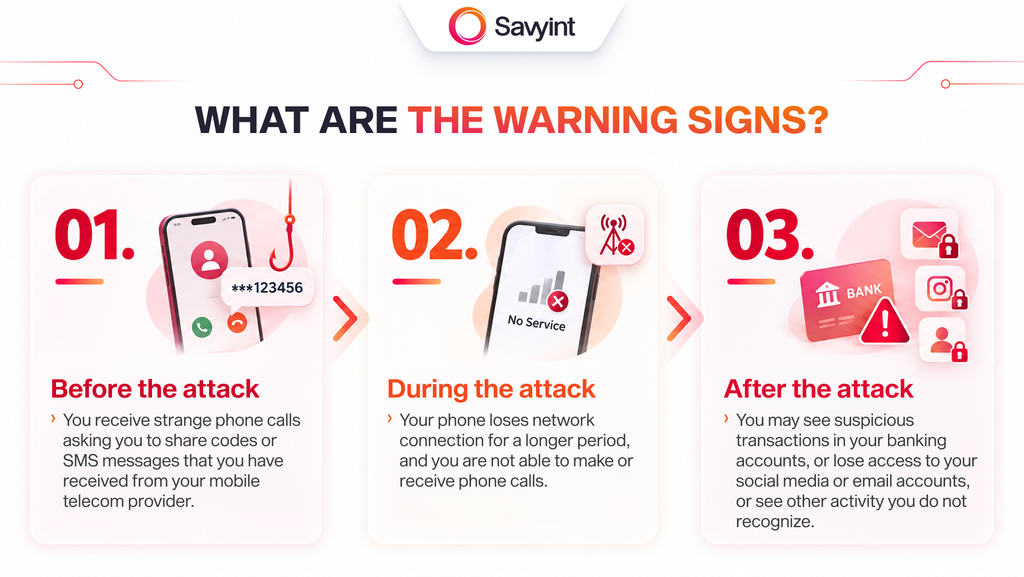
When the attack is successful, the legitimate subscriber’s phone loses its connection to the mobile network, preventing them from making or receiving phone calls.
2. 80% of SIM Swap Fraud Attempts Succeed Due to Weak Authentication
A study by Princeton University found that 80% of first attempts at SIM swap fraud were successful. One of the main reasons for this high success rate is the use of weak authentication methods by telecom operators, which can be easily bypassed by fraudsters. While each carrier has its own vulnerabilities in the SIM replacement process, none required direct identity verification or implemented strong multi-factor authentication, allowing fraudsters to carry out remote attacks with relative ease.
Telecom operators have often prioritized convenience over security, opting for simpler authentication methods to streamline customer service. In doing so, they may inadvertently create opportunities for fraudsters to exploit vulnerabilities. Lowering security standards to reduce friction for customers can ultimately weaken carriers’ defenses against SIM swap fraud.
The risks become even more serious when mobile banking applications rely heavily on phone numbers and SMS-based OTPs for identity verification. If a newly registered device can be activated primarily using customer credentials and an OTP, a successful SIM swap attack may give an attacker access to the victim’s bank account. Weak device-binding mechanisms, insecure account recovery processes, inadequate session controls, and insufficient verification when registering a new device can further increase this risk.
3. SIM Swap Fraud Is Not Just a Consumer Problem
SIM swap attacks are often viewed primarily as a threat to individual consumers, but they can have direct consequences for organizations as well. When an employee’s phone number is compromised, attackers can intercept one-time passwords (OTPs) sent via SMS and potentially gain access to corporate systems. This puts not only personal accounts at risk but also sensitive corporate data, financial assets, and customer records.
One of the most significant concerns is account compromise through SMS-based authentication. Many organizations still rely on mobile phone numbers for password resets or two-factor authentication. If an attacker gains control of an employee’s phone number, they may be able to change login credentials for email accounts, cloud services, or financial systems often without raising suspicion until it is too late.
The legal and reputational risks can be equally serious. Under the General Data Protection Regulation (GDPR) and the UK Data Protection Act 2018, organizations have obligations to protect personal and customer data. If attackers exploit weak authentication through a SIM swap attack, regulators may consider the incident in the context of data protection requirements. Beyond regulatory compliance, such incidents can also seriously undermine customer trust.
4. Measures to Prevent SIM Swap Fraud
For these reasons, security experts recommend that organizations and telecom operators move away from SMS-based authentication and adopt stronger identity authentication methods, such as Identity and Access Management (IAM), authenticator applications, or hardware security keys.
Banks can mitigate SIM swap fraud through measures such as strong device binding, risk-based authentication, transaction-level verification, controls over new-device registration, cooling-off periods for high-risk activities, real-time alerts, and server-side authentication and authorization controls.
Customers, meanwhile, should avoid sharing OTPs, PINs, or login credentials and should never install banking-related APK files from untrusted or unknown sources.
Ultimately, SIM swap fraud demonstrates why mobile banking security cannot rely on a single authentication factor. Instead, phone numbers, devices, customer identity, authentication processes, and transaction behavior should be treated as independent layers of security.
SIM swap attacks clearly demonstrate why organizations need protective measures that go beyond the security standards typically applied to individual consumers.
5. Building Digital Trust Beyond SMS-Based Authentication
SIM swap fraud highlights a broader challenge: digital security cannot depend on a single authentication factor – especially one tied to a mobile phone number.
As digital services become increasingly interconnected, organizations need a more comprehensive approach that can establish trust across the entire digital journey—from identity verification and authentication to device security, transaction protection, and fraud prevention.
This is where Digital Trust becomes critical. SAVYINT Digital Trust provides a comprehensive security ecosystem designed to protect identities, data, devices, applications, and transactions. Its capabilities span strong authentication, digital identity, PKI and encryption, transaction signing, consent management, device and application protection, and real-time fraud detection and prevention.
For banks, financial institutions, and digital service providers, this means moving beyond SMS-based OTPs toward stronger, multi-layered security—combining identity assurance, risk-based authentication, device intelligence, transaction-level verification, and cryptographic protection.
In the context of SIM swap fraud, such an approach can help organizations avoid relying solely on possession of a phone number as proof of identity. Instead, the user, device, application, transaction, and surrounding risk signals can be evaluated together to determine whether an access request or transaction should be trusted.
SAVYINT’s Digital Trust ecosystem is built to support this multi-layered approach, helping organizations strengthen authentication, protect sensitive data, prevent fraud, and establish trust throughout the digital customer journey.
Digital Trust is therefore not simply about stronger authentication. It is about creating a trusted digital environment where every identity can be verified, every access can be authenticated, every transaction can be protected, and suspicious activity can be detected before it becomes a major security incident.
Discover SAVYINT Digital Trust: savyint.com
6. How to Protect Yourself Against SIM Swap Attacks
Use app-based or hardware-based two-factor authentication instead of SMS
Avoid using SMS-based two-factor authentication whenever possible. Instead, opt for authenticator applications or use hardware security keys. These methods do not rely on your phone number and are therefore significantly less vulnerable to SIM swap attacks.
Limit the personal information you share online
Attackers often rely on publicly available information to impersonate their victims. The less personal information you share online such as your phone number, date of birth, or address the harder it becomes for criminals to build a convincing profile for impersonation.
Actively monitor your accounts
Enable login notifications for your most important accounts and regularly review account activity to identify unusual behavior. Identity protection services may also alert you if your personal information is exposed in data breaches or appears on dark-web marketplaces.
References
- European Union Agency for Cybersecurity (ENISA)
- Thomson Reuters Institute – SIM Swap Fraud
- Trend Micro
- Muhammad Ahsan Rauf’s post