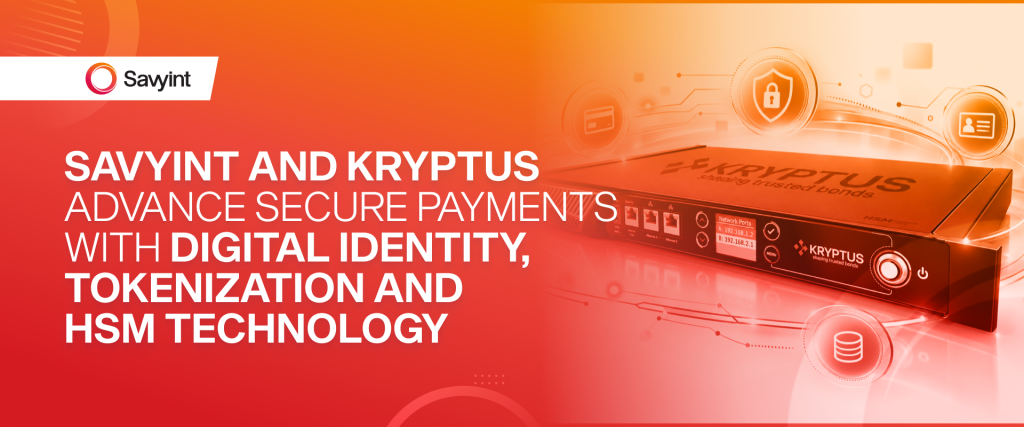
As digital payments, Open Banking and Digital Wallets continue to evolve rapidly, payment security is no longer limited to protecting card data. Financial institutions need a comprehensive security architecture that provides end-to-end protection – from user identity, authentication and transactions to cryptographic keys, payment data and API connectivity.
SAVYINT and Kryptus are working together to combine complementary capabilities in Payment HSM, Payment Tokenization, Digital Identity, Strong Authentication, Transaction Signing and Secure API, with the goal of building a Secure Payment Infrastructure for banks, digital wallets, Fintechs and digital payment ecosystems.
Under the partnership framework, Payment Tokenization has been identified as one of the key use cases, alongside Government Digital Identity & Digital Signing. This approach is designed to extend cryptographic protection and Digital Trust capabilities from the infrastructure layer to high-value digital financial transactions that require robust security, control and scalability.
Comprehensive Security Across the Entire Transaction Lifecycle
A digital payment transaction today can involve multiple components, including user identity, authentication mechanisms, banking or digital wallet applications, APIs, payment processing systems, card data, cryptographic keys and third-party services.
As ecosystems become increasingly interconnected, a vulnerability at any layer can potentially affect the security of the entire transaction. Payment security therefore needs to be designed as an end-to-end chain of trust, rather than focusing solely on individual components.
In the architecture envisioned by SAVYINT and Kryptus, the protection chain consists of: Digital Identity, Strong Authentication, Transaction Signing, Tokenization, HSM & Key Protection, Secure API, Audit & Compliance.
This approach connects Identity Trust with Cryptographic Trust and Payment Trust, creating the foundation for a secure and scalable digital payment architecture.
Payment Tokenization – A Key Focus of the Partnership
The growth of Apple Pay, Android Wallet, Digital Wallets, mobile payments and card-on-file services is transforming the way users store and make payments.
In this model, Payment Tokenization plays an important role in reducing direct exposure to sensitive payment data. Instead of using original payment data throughout transaction flows, tokens can be used in appropriate, controlled contexts and environments.
Payment Tokenization helps secure host-to-host connections and can therefore be applied across a wide range of use cases, including:
- Mobile Payments and Digital Wallets: Secure transactions across platforms such as Apple Pay, Google Pay and Samsung Pay, while supporting regulatory requirements for payments, e-wallets and digital identity wallets under eIDAS 2.0 and PSD2/PSD3;
- Card-on-File and E-commerce Payment;
- Payment Gateways;
- API Open Banking;
- Fintech Payment;
- Payment processing and connectivity systems.
For SAVYINT and Kryptus, Tokenization is not treated as an isolated security layer, but as part of a broader architecture encompassing HSM, Key Protection, Digital Identity, Authentication and Transaction Security. This combination is designed to protect not only payment data, but also the chain of trust underpinning every electronic transaction.
Payment HSM – The Foundation for Cryptographic Key Protection
Cryptographic keys are among the most critical assets within payment infrastructure. From encryption and authentication to payment information protection and cryptographic operations, the management and protection of keys have a direct impact on the security of the overall system.
This is why Payment HSM plays a foundational role in a Secure Payment Infrastructure architecture. With its capabilities in HSM and cryptographic security, Kryptus provides a layer of protection for cryptographic keys and cryptographic operations in high-security environments.
When combined with SAVYINT’s capabilities in PKI, Digital Signing, Authentication and Digital Identity, HSM becomes a foundational component of a Digital Payment Trust architecture — spanning from key protection to authentication and transaction security.
From Identity Authentication to Transaction Protection
A secure transaction must begin with accurately establishing identity and properly authenticating the party initiating the transaction. Strong authentication technologies, MFA and FIDO2/Passkeys help strengthen account protection and reduce reliance on traditional authentication methods that may be vulnerable to exploitation. However, user authentication is only one part of the equation.
For high-value transactions, systems must also be able to verify the transaction itself that the user is authorizing. This is where Transaction Signing plays a critical role.
Transaction Signing establishes a binding between an authenticated identity and the specific content of a transaction, enhancing protection against scenarios in which transaction details are altered or manipulated during processing. When Digital Identity, FIDO2/MFA and transaction signing are combined with HSM and Key Protection, the system can establish an end-to-end protection chain spanning the user, the transaction and the cryptographic assets supporting the transaction.
Secure API and Open Banking – Protecting the Connected Ecosystem
Open Banking is driving deeper connectivity among banks, Fintechs, Digital Wallets and third parties through APIs. This model creates significant opportunities for financial service innovation, while simultaneously expanding the attack surface and security requirements across the entire transaction flow.
API Security must therefore be treated as an integral component of Secure Payment Infrastructure. A transaction flow needs to be protected end-to-end, from Identity and Authentication through API and Transaction Signing to Tokenization, transaction processing and Audit.
Within this architecture, the combination of SAVYINT’s capabilities in Digital Identity, Authentication, Digital Signing and Transaction Security with Kryptus’s HSM and Key Security capabilities can create a unified layer of protection for Open Banking, Banking-as-a-Service, Digital Wallet and Fintech ecosystems.
Preparing for the Future with Crypto Agility and PQC
Next-generation payment infrastructure must not only address current security requirements but also be capable of adapting to changes in cryptographic technologies.
The development of Post-Quantum Cryptography (PQC) is introducing new requirements for financial institutions and payment infrastructure providers. Systems need to be designed with the ability to transition between cryptographic algorithms and mechanisms when required, rather than being tightly dependent on a single technology. This is the foundation of Crypto Agility.
An adaptable architecture needs to consider the ability to:
- Manage and replace cryptographic algorithms as required;
- Protect keys within HSM environments;
- Reduce dependency on any single cryptographic algorithm or mechanism;
- Prepare for the adoption of post-quantum algorithms when appropriate;
- Maintain compatibility with evolving security standards and requirements.
Integrating HSM, Key Management, Digital Identity and Secure Transaction Architecture from the design stage provides a strong foundation for future Crypto Agility and PQC readiness, particularly when the architecture is built by a provider with deep integration capabilities across the latest quantum-resistant technologies, such as SAVYINT.
From traditional banking to Digital Wallets, Fintech and Open Banking, payment infrastructure is becoming increasingly connected, distributed and complex. This also represents a natural expansion of Digital Trust. The collaboration between Kryptus and SAVYINT will bring a comprehensive solution ecosystem capable of addressing increasingly complex customer requirements, while supporting strict compliance with international standards for payment security, information security, digital identity and electronic authentication.
Contact us today for a comprehensive consultation!