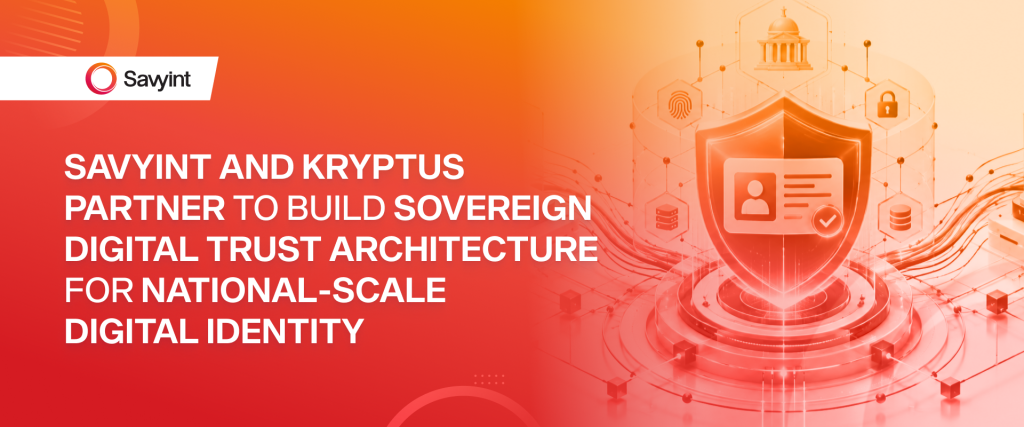
As countries accelerate the development of digital identity infrastructure and trusted digital services, the challenge is no longer limited to identity verification. It also requires building a Digital Trust foundation capable of protecting cryptographic keys, maintaining a robust Trust Hierarchy, ensuring transaction integrity, and meeting requirements for technological sovereignty.
SAVYINT and Kryptus are working closely together across HSM systems, PKI infrastructure, digital signing, timestamping, electronic identity, mobile identity, and FIDO2/Passkey technologies, laying the foundation for Sovereign Digital Trust architectures designed for governments and public-sector organizations.
This is not simply a combination of an HSM solution and a PKI platform. SAVYINT and Kryptus are pursuing a broader vision of connecting Cryptographic Trust with Identity Trust – from the protection of cryptographic keys to identity, authentication, and electronic transactions.
From Cryptographic Trust to Digital Identity Trust
A large-scale Digital Identity ecosystem requires multiple layers of trust to operate in coordination.
At the foundational layer, HSMs and the Root of Trust play a critical role in protecting sensitive cryptographic keys and establishing the foundation for PKI. On top of this foundation, components such as Trust Hierarchy, Certificate Policy/Certification Practice Statement (CP/CPS), Key Ceremony, TSA/Timestamping, and Digital Signing help establish and maintain a trusted chain across the entire system.
At the identity layer, Digital Identity, Mobile Identity, and FIDO2 extend the capabilities for authenticating and protecting user identities across digital environments.
It is the integration of these layers that creates a Digital Trust architecture capable of meeting requirements at scale. And this is precisely where SAVYINT and Kryptus can complement each other.
Kryptus – HSM and Root of Trust Foundation
Kryptus brings deep expertise in cryptographic security and HSM technologies, providing a foundation for protecting critical cryptographic keys in high-security environments.
Within a PKI architecture, an HSM is more than simply a security device. It can serve as a Root of Trust, protecting critical CA keys and supporting the establishment of a secure Trust Hierarchy.
Kryptus also brings technological experience within the ICP-Brasil ecosystem, including environments associated with Root CA and Brazil’s public digital certification infrastructure. In addition to HSM technologies, Kryptus develops technologies related to timestamping and time-source management, further extending the role of cryptographic infrastructure in Digital Trust services.
These capabilities form the Cryptographic Trust layer of the architecture envisioned by SAVYINT and Kryptus.
SAVYINT – PKI, Trust Services and Digital Identity
Building on the Root of Trust, SAVYINT contributes an ecosystem of Digital Trust and Digital Identity solutions, including TrustCA Remote Signing, TrustCA Timestamp, Passkey/FIDO2, and Mobile Identity.
These capabilities extend from key protection and Trust Hierarchy establishment to services that directly support users and electronic transactions.
Combined with Kryptus’s HSM and Root of Trust foundation, these capabilities create an end-to-end value chain spanning cryptographic foundation, trust services, digital identity, authentication, and digital transactions.
SAVYINT × Kryptus: Combining Capabilities to Build Sovereign Digital Trust
For governments and public-sector organizations, Digital Trust is increasingly linked to requirements for Sovereign Cryptography and Local Key Ownership.
A Sovereign Digital Trust architecture should enable organizations to maintain control over critical cryptographic assets and key components of their trust infrastructure, including:
- Root CA keys and other critical cryptographic keys;
- HSMs and Root of Trust;
- Trust Hierarchy;
- Certificate Policy (CP) and CPS;
- Key Ceremony and operational procedures;
- Digital Signing and Timestamping;
- Audit, assessment, and certification processes;
- Digital Identity and Authentication.
With this approach, organizations can build Digital Trust infrastructure aligned with domestic legal and governance requirements while maintaining interoperability with international standards and ecosystems, including:
- For identity, authentication, trust services, data encryption, and security devices: eIDAS 2.0, FIDO2/WebAuthn, OAuth 2.0, FIPS 140-3, NIST PQC;
- For information security and data protection: NIS2, GDPR, NIST PQC;
- For transaction and payment security: PCI DSS, PSD2/PSD3;
- For governance and system management: ISO 9001:2015, ISO 14001:2015, ISO 27001:2022.
Expanding further, countries can establish National PKI and National Digital Identity ecosystems, strengthening national sovereignty in cyberspace and enabling a more proactive and sustainable approach to digital trust.
Contact us today to connect with leading experts in Digital Trust and Digital Identity!
Securing the Root. Empowering Digital Identity. Building Sovereign Digital Trust.