As digital banking and mobile banking make payments and account management more convenient, financial fraud is also increasing at a rapid pace. Technologies such as biometrics, Smart OTP, Smart Token, and Passkey/FIDO2 are emerging as next-generation authentication methods. These passwordless authentication technologies help banks and financial institutions strengthen transaction security while significantly improving fraud prevention.
Traditional authentication methods are no longer secure enough
For many years, banking transactions have mainly relied on traditional authentication methods such as passwords, SMS OTP, and security questions. However, these methods are increasingly showing critical security weaknesses:
- SMS OTP can be intercepted through SIM swap attacks or stolen by malware on mobile devices.
- Passwords and personal information can be exposed through data breaches.
In response, financial regulators around the world are tightening requirements for strong authentication and encouraging banks and financial institutions to adopt more secure authentication technologies.
Some notable regulations include:
- European Union – PSD2: Requires Strong Customer Authentication (SCA) using at least two of the following three factors: Something the user knows (PIN, password); Something the user has (device); Something the user is (biometrics)
- Philippines – BSP Circular 1213: The Bangko Sentral ng Pilipinas (BSP) requires financial institutions to phase out SMS OTP for high-risk transactions before June 2026 and replace it with more secure authentication methods such as biometrics, device-based authentication, or passwordless authentication.
- Malaysia – BNM e-KYC Guidelines: Require financial institutions to implement facial recognition and liveness detection for digital customer onboarding.
- India – Aadhaar: The national digital identity system uses biometric authentication (fingerprint and iris recognition) to verify the identity of billions of citizens.
These regulations clearly reflect a global trend: passwordless authentication methods such as biometrics, Smart OTP, and Smart Token are becoming the new standard for financial security.
Why are biometrics, Smart OTP, and Smart Token more secure than traditional authentication?
Smart OTP
Smart OTP has become a widely adopted authentication method in digital banking. Unlike SMS OTP, Smart OTP is generated directly inside the banking application, tied to the user’s device and protected by cryptographic keys. Key advantages of Smart OTP:
- Generated within the banking app, preventing account takeover (ATO) via phone number hijacking or OTP interception.
- Implemented with device binding, meaning the OTP is valid only when generated on the registered device.
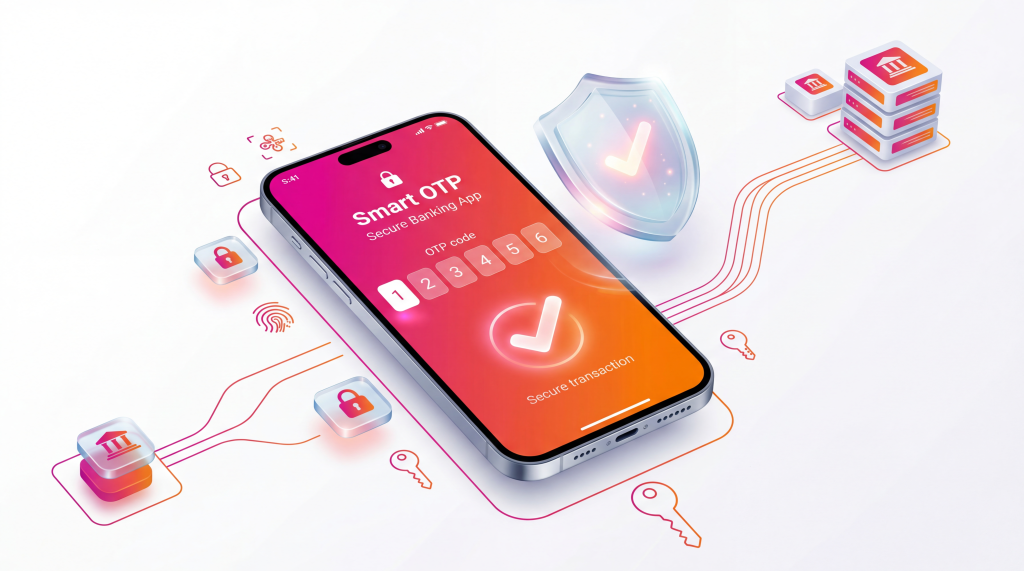
As a result, Smart OTP provides a critical additional security layer to protect digital banking transactions.
Smart Token
Alongside Smart OTP, Smart Token is another strong authentication method widely used by banks for high-value transactions. Smart Tokens can exist in different forms:
- Physical hardware tokens
- Software tokens integrated into banking apps, mobile apps, or web applications
Unlike standard OTP mechanisms, Smart Tokens use cryptographic algorithms to generate dynamic authentication codes tied to specific transactions.
This provides several security benefits:
- Authentication codes are generated based on transaction parameters, helping prevent transaction manipulation or spoofing attacks.
- Codes are difficult to steal or reuse.
- Well suited for high-value financial transactions or corporate banking operations.
Because of their strong security capabilities, Smart Tokens are often deployed as an additional authentication layer in electronic banking systems.
Biometrics
Biometric authentication verifies a user based on biological or behavioral characteristics. Common biometric technologies used in digital banking include:
- Fingerprint recognition
- Facial recognition
- Iris recognition
- Voice recognition
- Behavioral biometrics
Unlike passwords or OTP codes, biometric traits are unique to each individual and extremely difficult to replicate or forge, ensuring that the person performing the transaction is truly the legitimate account holder.
Another major advantage of biometrics is user convenience. Customers no longer need to remember passwords or wait for OTP codes. A simple fingerprint scan or facial recognition can authenticate a transaction instantly.

A growing trend in fraud prevention is behavioral biometrics. Instead of relying on physical traits, this technology analyzes how users interact with their devices, such as: Typing speed, Screen swipe patterns, App usage behavior,…Users do not need to perform any additional authentication step, yet the system can still detect suspicious behavior in real time.
Passkey / FIDO2
Another rapidly growing passwordless authentication trend is Passkey/FIDO2. A passkey is a FIDO-based credential that allows users to sign in to apps and websites using the same method they use to unlock their devices – biometrics, PIN, or device pattern – without entering a username, password, or additional authentication factors.
Passkey/FIDO2 offers extremely strong protection against phishing and credential theft because: A passkey works only with the specific domain or website where it was registered. If users visit a phishing or fake website, the passkey simply will not work. Passkeys are device-bound credentials, meaning authentication requires the registered device and user verification (biometrics or PIN).
In the digital banking era, security is no longer just a technical defense layer – it has become a core foundation for building digital trust between financial institutions and their customers. The combination of biometrics, Smart OTP, device-based authentication, and modern technologies such as Passkey/FIDO2 is paving the way for more secure authentication models, stronger fraud prevention, and seamless user experiences.
If your bank or financial institution is looking for modern passwordless authentication solutions, from biometrics, Smart OTP, Smart Token, and Passkey/FIDO2 to AI-powered behavioral analytics and fraud detection. Connect with Savyint’s experts today to explore how we can support your digital security transformation.
Read more:
- Strengthening Authentication and Security in the Financial and Banking Sector in Southeast Asia
- Establishing Digital Trust in Banking