
As organizations, especially those in finance and banking, e-commerce, and digital services, increasingly require stronger identity-based security models, device fingerprint has become an important component of modern authentication, fraud prevention, and risk control strategies.
What is Device Fingerprinting?
Device fingerprinting, also known as a “digital fingerprint for device identification,” is a method of identifying a device based on a set of software and hardware information, including:
- Browser type and version
- Operating system
- Screen resolution
- Time zone and language settings
- IP address and network signals
- Geographic location
When combined, these data points create a digital identity. Each device usually has a unique digital identity that enables recognition. Even if users delete cookies or start a new login session, the system can still determine whether the device is familiar or not.
This is also why device fingerprinting is widely used in authentication systems, fraud detection tools, and identity security platforms, as it adds an intelligent layer of identification that does not rely solely on usernames and passwords.
How Does Device Fingerprinting Work?
Like a miniature fraud detection system, device fingerprinting also operates based on the mechanism of: collecting information → combining the information to create a unique fingerprint → identifying the device over time.
Step 1: Collecting Device Attributes
When users access a website or log in to an application, the system begins collecting information related to the device, such as browser information including type, version, and plugins; operating system and device type; screen size and resolution; language and time zone; IP address and network signals, among others.
This data is collected passively and does not interrupt the user experience.
Step 2: Creating a Unique Fingerprint for the Device
After collecting sufficient information, the system combines these data points to generate a unique identifier, forming a distinct fingerprint value.
Step 3: Storing and Matching the Device Identity
Once the fingerprint is created, the system securely stores it on the server side. During the next login, the system compares the new fingerprint with previously known fingerprints.
- If there is a match: the user can continue accessing the system as usual.
- If there is a partial match: the system may require additional authentication.
- If there is no match: the access attempt may be flagged as risky, require further verification, or be blocked.
Instead of treating every login attempt the same way, the system adapts based on whether the device is trusted, allowing it to make appropriate follow-up decisions.
Benefits of Device Fingerprinting
Compared with traditional security measures, device fingerprinting enhances fraud detection capabilities in various scenarios, such as account takeover, fraud in digital account registration, and payment fraud, thanks to the following advantages:
- High accuracy: One of the key benefits of device fingerprinting is its ability to identify devices with a high level of accuracy. This technology uses multiple device attributes to generate a precise identifier, helping reduce false alerts, enable timely intervention, and minimize fraud risks.
- Persistent identification across multiple sessions: Unlike cookies, which can be deleted or expire, a device fingerprint can be maintained across multiple access sessions, allowing the system to track and monitor activity consistently over a longer period.
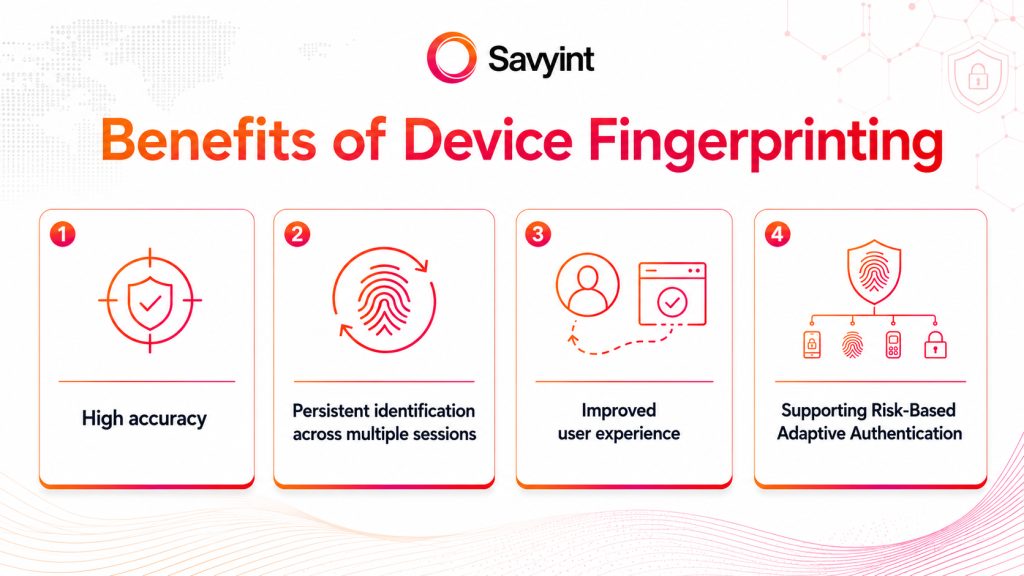
- Improved user experience: Device fingerprinting runs in the background, creating a smooth user experience without interruptions from cookie consent prompts. As a result, user interactions with websites become more seamless, improving engagement and satisfaction.
- Supporting Risk-Based Adaptive Authentication: Device fingerprinting plays an important role in adaptive authentication models. Instead of relying only on passwords or OTPs, the system can further analyze device familiarity, login location, network signals, and access behavior to make appropriate decisions. For trusted devices, the system can allow quick access. For new devices or those showing unusual signs, the system may require MFA, biometric authentication, token-based authentication, or temporarily block access.
Strengthening Fraud Prevention with Savyint’s Compliant and Secure Solution Suite
As organizations demand stronger security, device fingerprinting, together with advanced authentication methods and passwordless authentication, has become an essential component of modern security architecture.
This is also a key strength of Savyint’s comprehensive compliance and security solution suite. Designed based on Zero Trust architecture, Savyint’s solution suite combines multiple layers of modern security and authentication, including device fingerprinting, device intelligence, contextual authentication, and passwordless authentication such as Passkeys/FIDO2, biometrics, tokens, and smart OTP. This enables businesses and organizations to:
- Identify trusted devices
- Detect abnormal activities in real time
- Apply adaptive authentication based on risk levels
- Prevent fraud, account takeover, and unauthorized access
- Strengthen compliance with regulations on security, data, and digital transactions
Connect with Savyint’s experts today HERE to build a robust security and fraud prevention strategy from the ground up.
Read more: