To standardize formats and ensure verifiability, the European Telecommunications Standards Institute (ETSI) has issued a series of foundational standards for digital signature formats. One of the most important is TS 102 778, which provides guidelines for applying the ISO 32000-1 standard to PDF files. This standard is also known as PDF Advanced Electronic Signatures (PAdES).
The PAdES standard was developed to ensure that digitally signed electronic documents can be stored, retrieved, and used for decades. At any point in the future, even as technology advances dramatically, users must still be able to validate electronic documents – particularly the validity of digital signatures at the time of signing. This requirement laid the foundation for the development of Long-Term Validation (LTV) technology.
The introduction of the PAdES signature standard marked the standardization of advanced digital signature formats for PDF files, enabling long-term storage and validation.
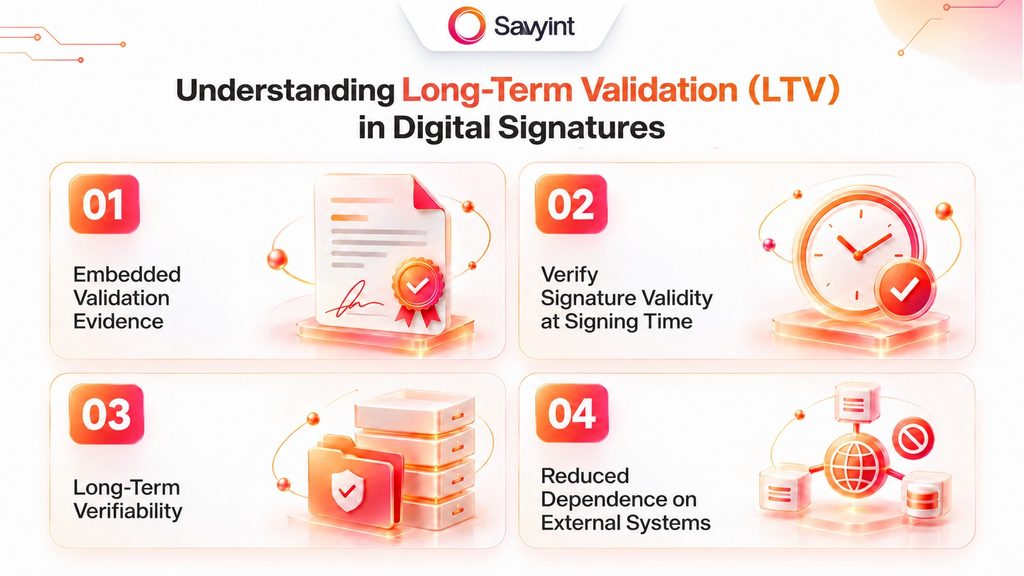
With Long-Term Validation (LTV) technology, the digital signing timestamp is recorded and stored directly within the electronic document. The LTV-enabled status is displayed in the digital signature parameters. Validation evidence is embedded directly in the electronic document, allowing the validity of the electronic record to be verified in the future without depending on the validity or revocation status of the digital certificate after signing. Since this evidence is stored within the digitally signed document, it is also authenticated and protected by the document’s digital signature, significantly minimizing the risk of errors or forgery. LTV technology is a valuable option for individuals, organizations, and businesses seeking to reduce their dependence on third-party systems and minimize future uncertainty regarding expired or revoked digital certificates.
Applying LTV to Digital Signature Solutions
Today, certain industries require the validity of a signature to be verifiable at the time of signing, making the adoption of advanced standards such as PAdES necessary. When Acrobat Reader or any other PDF software that supports digital signature validation opens a PDF document, it can readily validate the digital certificate used in the document-signing process without requiring separate digital signing applications provided by service providers. With LTV technology, signing-time data is stored directly in the document, allowing PDF software to validate the digital signature at the time of signing using the embedded timestamp information. As a result, PDF software can still verify the validity of the digital certificate at the time of signing, even if the original certificate has since expired or been revoked.
For electronic documents that have not been digitally signed using LTV technology, PDF software such as Acrobat Reader may encounter difficulties validating the digital certificate associated with the digital signature. If the certificate has expired, Acrobat Reader will display a yellow warning to the user stating, “At least one signature has problems.” This warning means that Acrobat Reader cannot determine whether the digital certificate was valid at the time of signing.
Savyint is one of the trusted providers of LTV digital signature solutions that fully comply with European and international standards.
Contact us today for consultation HERE!