Customer data is a valuable asset for organizations and businesses. Without a structured, transparent system, companies may face numerous challenges, or even risk compromising customer trust.
Typical Challenges in User Consent Management
Most businesses and organizations understand the importance of consent management. However, in practice, the majority still manage it manually, in a fragmented way, with limited oversight. Common challenges in managing user consent management include:
Incomplete or invalid consent collection
Many organizations collect consent through default checkbox plugins, registration forms, often accompanied by terms of service that span dozens of pages and combine multiple purposes. Unintentionally, these practices can violate fundamental data protection laws, as they may not rely on voluntary consent and often fail to provide full, specific, clear, and detailed information to users.
Fragmented consent management
Organizations interact with customers through multiple touchpoints: mobile apps, internet banking, service counters, emails, SMS, and more. Each channel often has its own mechanism for collecting consent, which can lead to:
- Data duplication: Consent appears repeatedly across multiple reports
- Data inconsistency: Users may opt out of marketing emails but still receive SMS; consent updated on a mobile app may not sync with the website
- Loss of consent management when integrating with other platforms
These inefficiencies affect user experience and complicate organizational data management.

Non-compliance with legal regulations
Data protection laws are constantly evolving. What is valid today may no longer be valid tomorrow. Different regions and countries have different requirements. Violating international regulations can result in fines up to €20 million or 4% of annual global revenue under GDPR (EU), or USD 7,500 under CCPA (US). In Vietnam, banks must comply with the Personal Data Protection Law 2025 and Decree 356/2025/ND-CP. User personal data must be collected, stored, processed, and shared transparently, with mechanisms ensuring user rights to access, edit, revoke consent, and delete data when no longer necessary. Ensuring ongoing compliance with both international and local regulations is a significant challenge for organizations.
Modern Consent Management Architecture
Today, a modern consent management system is more than just a pop-up or a checkbox form. It is a complex technical system with multiple layers, ensuring that consent is collected accurately, stored securely, and remains consistent across the organization’s digital ecosystem. A modern consent management system typically includes the following pillars:
- Multi- channel consent collection: Systems allow consent management collection via mobile apps, websites, self-service kiosks, service counters, and more. eKYC integration ensures that only genuine customers can provide consent, improving data accuracy and reliability.
- Consent information management: All consent, including the time of agreement, the content of the terms accepted, version IDs, and the full history of user choices, is stored centrally.
- Compliance: Personal data is collected and processed only within the scope of the consent provided. When a user withdraws consent, the system must immediately stop access and usage of the data as requested.
- Storage and auditing: All activities related to customer consent (collection, changes, withdrawal, data access) must be fully recorded in immutable logs. These records must include timestamps, digital signatures, and be tamper-proof, with legal validity according to regulations. The minimum log retention period meets the requirements of each country.
About Savyint Consent Management
SAVYINT is a global technology company with extensive experience in building secure digital infrastructure and digital trust for financial institutions, governments, and large enterprises.
Built on an API-first and Zero Trust architecture, Savyint Consent Management automates the entire consent management process – from collection and storage to verification and revocation – ensuring transparency and control over user data.
Integrating advanced technologies such as AI/ML and Post-Quantum Cryptography (PQC), Savyint Consent Management leverages immutable logs and homomorphic encryption to maximize security for sensitive data, enabling organizations to:
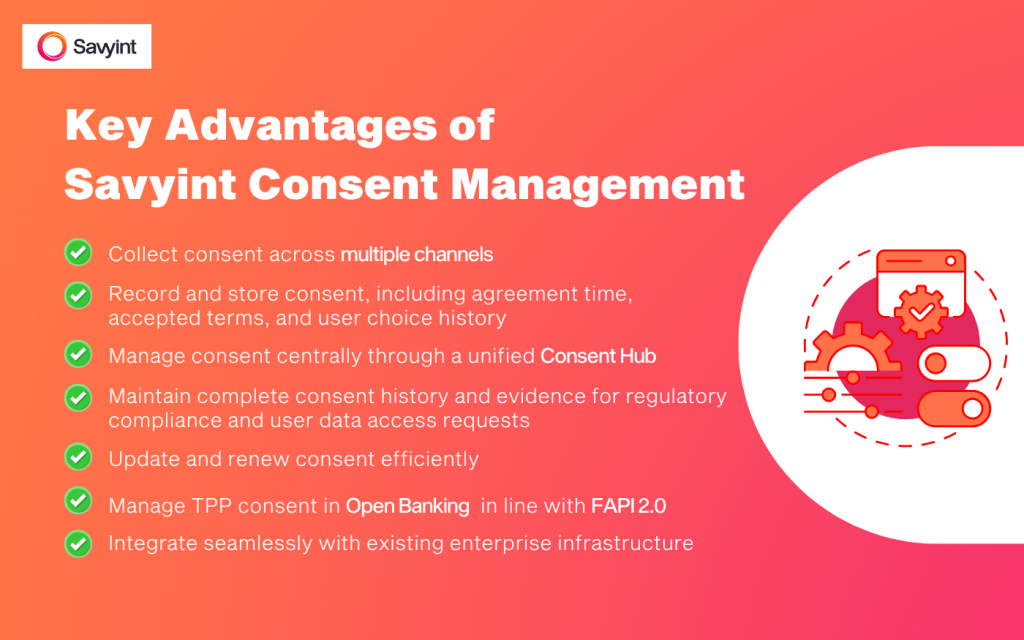
- Collect consent across multiple channels
- Record and store consent, including the time of agreement, the content of the terms accepted, and the history of user choice changes
- Manage consent centrally on a Consent Hub
- Maintain a full history and evidence of consent to demonstrate compliance with data protection regulations and support user data access requests
- Update and renew consent
- Manage TPP consent in Open Banking according to FAPI 2.0
- Integrate seamlessly with existing infrastructure
Savyint Consent Management meets international standards such as GDPR, PDPA, CCPA, ISO 27701, PCI DSS, and local regulatory requirements in countries including Vietnam (Personal Data Protection Law 2025, Decree 356/2025/ND-CP, Circulars 64, 50, 77 from the State Bank of Vietnam), Singapore (PDPA), and more.
Upgrade your consent management system and protect customer data today with Savyint, CONNECT NOW.