

Workshop “Implementing safe, reliable Open Banking and complying with Circular 64 & 50/2024/TT-NHNN”: Key Topics You Should Not Miss
As an important event for experts, financial institutions, and banks, the workshop provides updates on Open Banking trends, technology solutions, and the latest regulatory compliance guidelines. Open Banking is becoming a critical pillar in the digital transformation strategy of the Vietnamese financial–banking sector. However, for effective implementation, banks must not only adopt advanced technologies but also ensure compliance with legal regulations, data security, and strong customer authentication in accordance with Circular 64 and Circular 50/2024/TT-NHNN. The workshop “Implementing Open Banking Safely, Reliably, and in Compliance with Circulars 64 & 50/2024/TT-NHNN” is an unmissable event for experts in legal affairs, banking, and technology. Leading technology specialists will deliver in-depth presentations, provide implementation insights, and share strategic orientations to support banks on their journey to realizing Open Banking in Vietnam. Below are the key discussion topics featured at this workshop. Presentation on Circular 64/2024/TT-NHNN Experts will break down the detailed requirements and guidelines of Circular 64, including secure data sharing between banks and third parties, customer information protection mechanisms, and the compliance roadmap for financial service providers. This will help banks clearly understand the legal framework and the necessary steps to implement Open Banking lawfully and securely, minimizing legal risks during deployment. Implementing Open Banking with Legal Compliance, Trusted Security, and Strong Authentication under Circulars 64 & 50/2024/TT-NHNN This session will introduce technology solutions that enable banks to implement Open Banking while maintaining full legal compliance, ensuring security, and meeting strong customer authentication (SCA/MFA) requirements under Circulars 64 & 50. These may include secure API architectures, international-standard data protection mechanisms, and strong authentication methods. The solutions aim to optimize customer experience while minimizing security risks. The API Economy in Bank Digital Transformation The presentation will highlight the role of APIs in expanding digital service ecosystems, and explain how to leverage API value to accelerate innovation and create competitive advantages for financial institutions. Ensuring Secure and Compliant Open Banking & Digital Banking Implementation under Circulars 64 & 50/2024/TT-NHNN This session will focus on advanced security standards for Open Banking, including identity governance, access control, and API integration. It emphasizes embedding regulatory requirements into operational workflows to ensure continuous compliance and reduce security vulnerabilities. Data Protection in the Era of AI and Quantum Computing As AI and quantum computing advance rapidly, data protection becomes a top priority. Experts will discuss cutting-edge data protection methods that help banks maintain customer trust and comply with security regulations. The workshop “Implementing safe, reliable Open Banking and complying with Circular 64 & 50/2024/TT-NHNN” promises to deliver practical perspectives, technical solutions, and comprehensive implementation strategies for Vietnam’s emerging open financial ecosystem. With participation from pioneering organizations in digital transformation, data security, and banking infrastructure, the event will offer valuable insights to help financial institutions adapt to new regulatory frameworks, enhance security, and build a sustainable digital service foundation. Implementing safe, reliable Open Banking and complying with Circular 64 & 50/2024/TT-NHNN Time: 8:30 – 12:00, November 21, 2025Venue: Hotel du Parc Hanoi, 84 Tran Nhan Tong street, Hai Ba Trung ward, HanoiRegistration link: https://openbankingforum.org/hoi-thao-ngan-hang-mo/
Meet Leading Experts at the Workshop “Implementing safe, reliable Open Banking and complying with Circular 64 & 50/2024/TT-NHNN”
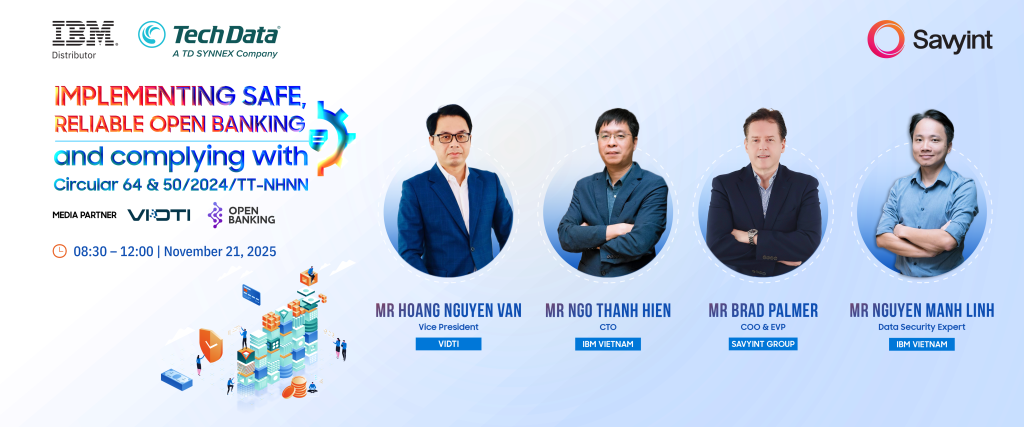
With the goal of helping banks and financial institutions shape effective, secure, and sustainable Open Banking strategies, the workshop brings together leading experts in Information Technology, Security & Legal Compliance, and Banking–Finance. As Vietnam’s financial and banking sector enters a period of strong transformation, implementing Open Banking in alignment with the directions of Circulars 64 & 50/2024/TT-NHNN has become a key mission to ensure safety, compliance, and innovation. The workshop “Implementing safe, reliable Open Banking and complying with Circular 64 & 50/2024/TT-NHNN ” gathers top technology, legal, and data security experts from Savyint Group, the Vietnam Institute of Innovation & Digital Transformation (VIDTI), and IBM Vietnam. Combining strategic perspectives with practical experience, the speakers will share critical solutions that help banks meet new regulatory requirements, protect user data, and build Digital Trust in the era of open finance. Let’s explore the experts who will be joining this event with Savyint. Mr. Hoang Nguyen Van, Vice President, Vietnam Institute of Innovation & Digital Transformation (VIDTI) With many years of experience in digital transformation and policy development, and as a Senior Expert and Technical Standards & Compliance Director of the Open Banking Exchange, Mr. Hoang Nguyen Van will deliver comprehensive insights on security, strong customer authentication (SCA/MFA), and the regulatory framework for implementing Circulars 64 & 50/2024/TT-NHNN. He will also present end-to-end solutions enabling banks to simultaneously achieve innovation and compliance. Mr. Ngo Thanh Hien, Chief Technology Officer, IBM Vietnam As a leading technology expert in cloud security infrastructure, Mr. Ngo Thanh Hien will discuss the role of APIs, building the API economy, and how banks can leverage open platforms to innovate products, optimize operations, and expand collaboration with third-party providers. Mr. Brad Palmer, Chief Executive Officer & Vice President, Savyint Group With extensive experience in identity management, strong authentication (MFA/SCA), and data security, Mr. Brad Palmer will present approaches to ensuring safety and compliance in the Open Banking model—supporting banks in meeting regulatory standards under Circulars 64 & 50/2024/TT-NHNN. Mr. Nguyen Manh Linh – Data Security Expert, IBM Vietnam Mr. Nguyen Manh Linh will share in-depth insights into data protection strategies, encryption, and security risk prevention in the context of rapid advancements in AI and quantum computing—opening new pathways for banks to safeguard digital assets and customer trust. With the participation of leading experts from the State Bank of Vietnam, VIDTI, and global technology enterprises such as Savyint Group and IBM Vietnam, the workshop promises to deliver multidimensional, insightful, and practical perspectives on the journey of implementing Open Banking in Vietnam. This will be a valuable opportunity for banks, financial institutions, and technology partners to discuss, connect, and shape the future of Vietnam’s digital finance landscape. Implementing safe, reliable Open Banking and complying with Circular 64 & 50/2024/TT-NHNN Time: 8:30 – 12:00, November 21, 2025Venue: Hotel du Parc Hanoi, 84 Tran Nhan Tong street, Hai Ba Trung ward, HanoiRegistration link: https://forms.office.com/e/TZvYePQqCB Event Details: https://savyint.com/implementing-safe-reliable-open-banking-and-complying-with-circular-64-50-2024-tt-nhnn/
Implementing safe, reliable Open Banking and complying with Circular 64 & 50/2024/TT-NHNN
Open Banking is not only a global trend but also one of the key pillars in the digital transformation strategy of Vietnam’s financial and banking sector. Expanding connectivity and data sharing between banks and third-party providers (TPPs) opens up opportunities for service innovation and customer-centric financial ecosystems. Alongside these opportunities come significant challenges related to regulatory compliance, data protection, and strong customer authentication (SCA/MFA), as stipulated in Circulars No. 64 and 50/2024/TT-NHNN issued by the State Bank of Vietnam (SBV). To provide a comprehensive perspective from policy to technology to implementation, Savyint Group, in collaboration with the Vietnam Institute for Innovation and Digital Transformation (VIDTI), IBM Vietnam, and Techdata, will host the workshop: “Implementing safe, reliable Open Banking and complying with Circular 64 & 50/2024/TT-NHNN” The event will take place on Friday, November 21, 2025, from 08:30 to 12:00 at Hotel du Parc Hanoi, and will also be livestreamed via Zoom Webinar, enabling individuals and organizations interested in banking technology and digital transformation to join remotely. The workshop will bring together representatives from Savyint Group, along with experts from the Information Technology Department of the State Bank of Vietnam, the Vietnam Institute for Innovation and Digital Transformation (VIDTI), and IBM Vietnam, to share key insights on the following topics: This workshop offers a valuable opportunity for banks, financial institutions, and technology partners to gain a deeper understanding of the regulatory frameworks, technical standards, and modern security solutions required to successfully implement Open Banking in Vietnam. With the participation of leading organizations in digital transformation, information security, and financial technology, the event promises to deliver practical insights, international best practices, and strategic directions to help Vietnam build a secure, transparent, and trusted open financial ecosystem. 👉 Register now to join the workshop: https://forms.office.com/e/TZvYePQqCB
Savyint Proudly Sponsors World Financial Innovation Series (WFIS) 2025 Philippines as Bronze Sponsor

Savyint is honored to be a Bronze Sponsor of the World Financial Innovation Series (WFIS) 2025 Philippines, the premier fintech event in the ASEAN region, organized by Tradepass. The event will bring together over 600 leaders and experts from the finance, banking, and insurance sectors, representing more than 200 organizations across the region. The Philippines is at the forefront of the digital financial transformation, with the online lending market projected to reach USD 1.68 billion by 2027 and over 65 million e-wallet users expected by 2025. Additionally, electronic payments account for 52.8% of total retail transactions, reflecting the widespread adoption of digital technologies in financial services. This surge is driven by three key factors: supportive government policies, the rapid rise of fintech, and the growing demand for a comprehensive financial ecosystem. Initiatives led by the Bangko Sentral ng Pilipinas (BSP), such as the Open Finance pilot program and Project Nexus for enhanced cross-border payments, underscore the country’s commitment to fostering financial inclusion and sustainable development. Against this backdrop, WFIS 2025 Philippines, hosted by Tradepass, serves as a pivotal platform, uniting over 600 industry leaders and experts from 200 organizations. Under the theme “Bridging Financial Gaps for a Digitally Smart Philippines,” WFIS 2025 is more than an event—it is a hub for strategic collaboration and discussions on critical topics such as Open Finance, Central Bank Digital Currency (CBDC), and the application of AI and blockchain in financial services. With over 300 active fintech companies and online payments comprising 52.8% of retail transactions, WFIS 2025 is the ideal stage to shape the future of fintech in the Philippines and drive financial innovation. Over the course of two days, WFIS 2025 Philippines will feature a robust lineup of activities, including: As a Bronze Sponsor, Savyint is represented at the event by Mr. Steve Hoang, Chief Technology Officer, and Mr. Brad Palmer, Chief Operating Officer and Executive Vice President. Savyint’s leadership will engage with top regional executives, investors, and strategic partners, sharing insights on secure digital transformation, electronic identity, and building digital trust within the financial ecosystem. Mr. Brad Palmer stated: “WFIS 2025 is a vital platform for Savyint to connect with strategic partners in the region while reaffirming our long-term commitment to delivering advanced security, identity, and digital finance solutions. This event provides an opportunity to showcase our latest technologies, engage with banking and fintech leaders, and contribute to the secure and sustainable growth of the Philippines’ and ASEAN’s financial ecosystems.” With over 20 years of expertise in developing encryption, identity, and authentication solutions, Savyint offers the market’s most comprehensive authentication platforms, fully compliant with BSP Circular No. 1213. The company is dedicated to supporting the Philippines’ financial sector by implementing modern security standards, combating fraud, and fostering digital trust. Images from the event:
Savyint Partners with WFIS 2025 Philippines
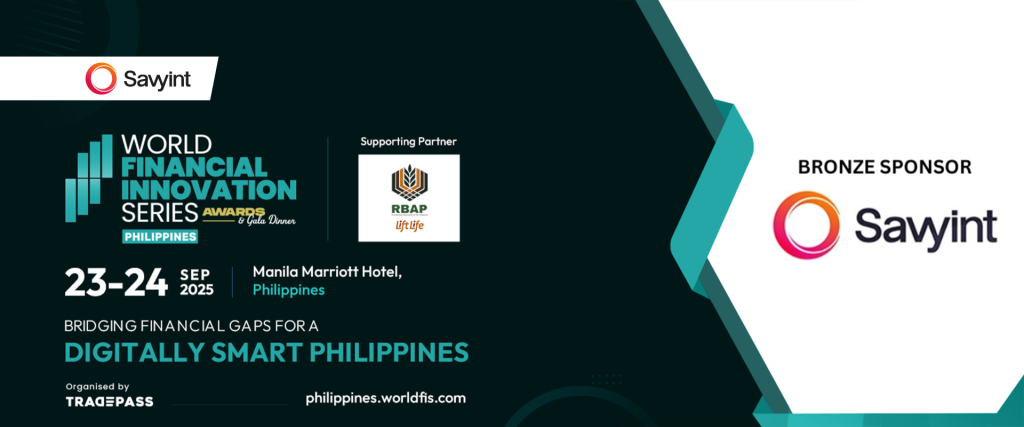
Held in the Philippines, the World Financial Innovation Series (WFIS) 2025 Philippines is one of ASEAN’s leading finance and technology events, attracting more than 600 experts and organizations from the banking, insurance, and financial sectors. Savyint is proud to join this year’s edition as a Bronze Sponsor. With the theme “Bridging Financial Gaps for a Digitally Smart Philippines”, WFIS 2025 is set to bring together over 600 senior leaders and financial experts from more than 200 organizations across the region. The event will highlight today’s most pressing technology topics—including the future of Fintech, AI, Blockchain, and Automation in Finance – making it a premier platform that connects financial service providers, technology innovators, and business leaders. WFIS 2025 promises to drive forward groundbreaking initiatives, showcase pioneering solutions, and foster comprehensive strategic partnerships. As a Bronze Sponsor, Savyint is honored to stand alongside WFIS 2025, advancing our global strategy while showcasing our core values in security, digitalization, and safe financial transformation to the financial community in the Philippines and ASEAN. Savyint believes that WFIS 2025 will unlock outstanding opportunities for collaboration, fueling digital transformation not only in the Philippines but also across the globe. Join us on this journey at WFIS 2025 Philippines: https://www.philippines.worldfis.com/
Can Central Bank Digital Currency Work Offline?
A Central Bank Digital Currency (CBDC) is being envisioned to replace a major percentage of cash transactions across the world. China, for example, is very close to being a cashless society1. As a result, banks are shutting down their branches and discouraging cash deposits and withdrawals in China, to encourage the use of the Chinese Digital Yuan. As and when the CBDCs across the countries launch and start replacing cash transactions, the dependency of a country’s trade and economy shall increase on retail CBDC transactions, and in such a case, a power outage or loss of contact with the ledger, can bring the economy to a still. Therefore, as a backup, CBDCs should also have the capability to transact offline. This functionality shall make Retail CBDC transactions similar to cash transactions. Problem Statement – What is Exactly an Offline Retail CBDC Payment? A transaction is defined as an offline transfer if: An offline CBDC ecosystem consists of a Central Authority, a bank, a merchant, and a spender. The model proposed by VISA3, works on a Two-Tier Hierarchical Model where the Central Bank, authorizes a bank or a financial institution to provide a cryptographic key to the digital wallets held by the payee and payor. These digital wallets hold balance that is either transferred from the bank account or Central Bank directly. Accessing a digital wallet and moving money from one digital wallet to another requires an individual to be present online. However, to move money offline, in the absence of an intermediary bank, and during a temporary network outage, an Offline Payment System (OPS) is required. To put it in simpler terms, Individual A holding Digital Wallet A should be able to transfer money to Individual B holding Digital Wallet A/B (Where A and B are different Digital Wallet Providers), without having to involve Bank or Digital Wallet provider, when the network is temporarily not available. Before understanding the offline retail CBDC transfer, it is important to understand how retail CBDC works. Offline CBDC transfer works best with Token Based Retail CBDC transfer, where the actual movement of tokens takes place from the spender/payor to merchant/payee. How Does Offline CBDC Transfer Work? The smartphone and tablet’s secure hardware has the capability to store authentication keys and is next to impossible to tamper with the information saved in it. It can only be accessed using strong authentication techniques like biometrics. Therefore VISA in its study4, recommends the use of Mobile/Tablet’s hardware as a store for CBDC funds, offline. Further, as per IMF5 Giesecke+Devrient is working on storing offline CBDC in an offline smart card. Steps Involved in Offline CBDC Transfer Initialization The first step to facilitate an Offline CBDC transfer is to register and get an authentication key for the digital wallet, smartphone/tablet’s secured hardware, or smart card. The user shall need to share his/her documents for KYC with the financial institution authorized by the Central bank to issue the authentication certificate key for the digital wallet, smartphone/tablet’s secured hardware, or smart card. These, thereafter become, trusted entities and can participate in the offline CBDC transfer. This is a one-time process. Withdrawal The user then needs to transfer the retail CBDCs from his/her digital wallet to a smartphone/tablet’s secured hardware, or smart card. This means, that the user is transferring retail CBDC from his online digital wallet balance to the smartphone/tablet’s secured hardware, or smart card’s offline CBDC balance. Payment When the user goes to a merchant to purchase, the merchant using the Mobile app or POS creates a payment request for the user. Since the network is not available, the payment request generated by the merchant, using Near Field Communication (NFC) or with the help of POS, presents the payment amount and merchant’s certificate to the user’s smart card or smartphone/tablet’s secured hardware. The Offline Payment System Protocol (built-in smart card and smartphone/tablet’s secured hardware), checks the user’s offline CBDC balance and thereby deducts it and creates a Payment Message for the merchant which contains: On presenting the Payment Message to the merchant’s mobile application or POS, the validity of the user’s certificate, CBDC coin unique identification number, the unique transaction number, and payment amount are validated. If all checks are successful and authenticated, the Payment Message is stored in the merchant’s smartphone/tablet’s secured hardware, or offline smart card. Deposit After the Payment Message is stored in the merchant’s smartphone/tablet’s secured hardware, or offline smart card, he/she can thereafter transfer it to their digital wallet, when the network is resumed. While initiating the transfer, the digital wallet shall check if the payment message is new and was not previously encashed. On successful verification, the amount gets transferred to the merchant’s digital wallet and starts reflecting as an online CBDC balance. In case, if the network outage is for a longer duration, and the merchant, has huge offline Payment Messages stored with him, he/she can use already stored Payment Messages to make offline payments for his purchases. This shall act as an incentive for the merchant to remain cashless even during a network outage What are the Challenges of Offline CBDC Payment in Absence of a Network? Double Spend In the absence of a network, while doing an offline retail CBDC transfer, the transactions rely on the transfer of messages. If a single retail CBDC coin, is mischievously used simultaneously for 2 transactions for two different merchants, it is referred to as a ‘double spend’. The problem with ‘double spend’ is that when the network resumes, and the merchant tries to settle the offline retail CBDC coin, it makes the CBDC coin unavailable for the second merchant as it is already settled by the 1st merchant and hence fails the purpose of the offline payment. How to tackle the problem? When the merchant sends a payment request to the payor, on successful verification, the offline CBDC balance is deducted from the payor’s smart card or smartphone/tablet’s secured hardware, and a log is created with the CBDC coin’s unique identification number
Savyint Officially Launches Open Banking Tech Stack, Driving Open and Inclusive Finance Ecosystems

Savyint has officially announced the launch of its Open Banking Tech Stack, marking a significant milestone in the journey of building an open and inclusive financial ecosystem in Vietnam and across the region. As the global financial industry undergoes a strong transformation towards open finance models, implementing open banking is no longer just a trend but a strategic imperative for financial institutions to maintain competitiveness. The growing demand for connectivity between financial ecosystems – including banks, enterprises, and end-users – requires an infrastructure that not only complies strictly with regulatory frameworks but also ensures the highest level of data security and privacy. With this vision, Savyint introduces the Open Banking Tech Stack – a comprehensive solution designed to help banks, financial institutions, and enterprises accelerate digital transformation, foster innovation, and contribute to shaping an open and inclusive financial ecosystem. Open Banking Tech Stack – Bridging Technology and Compliance The Open Banking Tech Stack is designed to strictly meet both regulatory and technological requirements, enabling banks and financial institutions to enhance connectivity, collaboration, and innovation within a globally integrated system. Key Advantages of the Open Banking Tech Stack: The Open Banking Tech Stack equips organizations with a complete set of tools to implement a modern open banking system, including: In addition, the Tech Stack integrates seamlessly with secure online payment gateways, creating a complete end-to-end process for banks and third-party providers – from registration, identification, authentication, integration, and data sharing to payments. Strategic Partnerships with Global Technology Leaders Savyint’s Open Banking Tech Stack is built on strategic collaborations with world-leading names in Open API and Open Banking, including Red Hat, Axway, Tyk.IO, Kong, Curity, Salt Group, IBM, Google Cloud, Gravitee, Fiorano, and Open Banking Exchange. Through these partnerships, Savyint not only delivers cutting-edge technology solutions but also provides customized adaptability to meet the specific needs of each market – ensuring reliability, optimal security, and exceptional scalability. The Open Banking Tech Stack is expected to break down traditional barriers, enabling intelligent data sharing and close collaboration among stakeholders. This fosters healthy competition, drives innovation, and lays the foundation for a new era of inclusive finance. Don’t stand outside the open banking movement, connect with Savyint experts TODAY!
Tourist e-Wallet and Digital Dirham: Great Potential but Significant Challenges
To meet the operational demands of the digital economy and enhance the efficiency of payment systems, the Central Bank of the UAE (CBUAE) has introduced the national digital currency, the Digital Dirham. Recently, the CBUAE discussed four potential use cases for the Digital Dirham, with the development of an electronic wallet for tourists being a particularly prominent topic. The CBUAE recently released the Digital Dirham Primer, a policy report outlining the design principles, policy framework, and initial development steps for the Digital Dirham. In addition to highlighting benefits, challenges, and implementation processes, the report details four use cases for the digital currency, including: Among these, the concept of an electronic travel wallet for tourists has garnered significant attention, given that the UAE attracts millions of international visitors annually, who collectively spend vast amounts on accommodation, shopping, dining, and entertainment. Theoretically, even if just 10% of tourism spending shifts to the Digital Dirham wallet, it could create a substantial economic impact and promote the adoption of the digital national currency. However, launching a tourist e-wallet is not as simple as introducing it to the market and expecting adoption. Most tourists in the UAE rely on Apple Pay, Google Pay, international credit/debit cards, or digital wallets from their home countries, such as UPI (India) or Alipay and WeChat Pay (China). For tourists to adopt a new payment method like the Digital Dirham, it must offer superior value and address inconveniences that existing infrastructure fails to resolve. Key considerations include: The electronic travel wallet scenario is a complex challenge involving multiple factors, including user experience, cost, widespread payment acceptance across various locations, and integration with diverse payment methods. If these elements are effectively addressed, capturing 10% of the tourism spending market share is entirely feasible. Banks and wallet developers must carefully strategize to turn this potential into tangible success.
Curity and Savyint Partner to Advance Identity and API Security for Open Banking in APAC

In July 2025, Savyint, an IT product company specializing in information security, payment security and open banking, and Curity – A global leader in identity and access management (IAM) platforms, announced a strategic partnership to strengthen identity management, user authentication and API security in Open Banking in Vietnam and the broader APAC region. Aligned with Vietnam’s strategy to build a modern digital economy and supported by regulations laying the foundation for open banking, Savyint and Curity collaborate to deliver IAM and API management (APIM) solutions that ensure flexibility, security, and compliance with open banking standards. The partnership focuses on developing highly secure IAM and APIM solutions for the financial and banking sector, adhering to global security and identity standards including OAuth2, OpenID Connect (OIDC), and FAPI – aligned with PSD2, mTLS, and others. Joint solution highlights: This comprehensive authentication, identity management and API security solution serves as the core foundation in the open banking, enabling seamless integration for banks and third-party providers (TPPs), ensuring interoperability with APIM platforms and meeting the technical standards outlined in Circular 50/2024/TT-NHNN on security for online banking services and Circular 64/2024/TT-NHNN on implementing open APIs in the banking sector. Compared to other IAM platforms, Curity demonstrates superior security, compliance with international standards, and deployment flexibility, supporting over 40 security standards like OAuth2, OpenID Connect, FAPI, PKCE, SAML, CIBA, CDR, HSM keystore, Mobile SDK, MFA/SCA, and more. Notably, Curity offers over 30 authentication methods and a specialized Consentor module, a feature not commonly found in other platforms. With PCI DSS compliance, Phantom Token and Token Handler support for SPAs, Curity is an ideal choice for open banking systems requiring high financial security and long-term scalability. According to Kuppinger Cole’s API Security and Management report, Curity ranks among the top leaders in technology and performance, underscoring its ability to deliver robust API security solutions aligned with modern trends, particularly in IAM and API security per standards like OAuth 2.0 and OpenID Connect. Mr Brad Palmer, Chief Operating Officer & Executive Vice President of Savyint, stated: “Our partnership with Curity enables Savyint to deploy advanced IAM solutions that meet the stringent requirements of open banking in Vietnam. With flexible authentication methods, consent management and HSM integration, together with Curity, we will build a secure, transparent, and efficient ecosystem.” Mr Stefan Nilsson, Chief Commercial Officer at Curity, added: “We are excited to collaborate with Savyint to advance open banking in Vietnam. Partnering with Savyint allows us to apply Curity’s global IAM expertise to local markets with precision, fostering secure and scalable open banking frameworks.” About Curity Founded in 2015, Curity is a leading provider of identity management solutions, trusted by major organizations in sectors such as finance, telecommunications, retail, online gaming, energy, and government across multiple countries. Curity focuses on delivering identity and API security solutions compliant with open standards like OAuth 2.0, OpenID Connect, FAPI 1&2, Mobile SDK, MFA/SCA, ensuring data security and optimized user experiences. Curity’s core system, the Curity Identity Server, is recognized as the most comprehensive server supporting OAuth and OpenID Connect standards. Curity is headquartered in Stockholm, Sweden, with a global team of experts. About Savyint Savyint is an IT security company based in Sydney, Australia with an R&D center in Hanoi and international offices in Singapore, Dubai, Ho Chi Minh City (Vietnam), and Sofia (Bulgaria). With over 20 years of experience, Savyint is among the world’s leading IT companies, providing software platforms, system solutions, and services for digital transformation. Its expertise includes open banking, information security, and FinTech, particularly in the Finance & Banking, FSI, Government, Manufacturing, Telecommunications, Healthcare, Education, and Media sectors.